


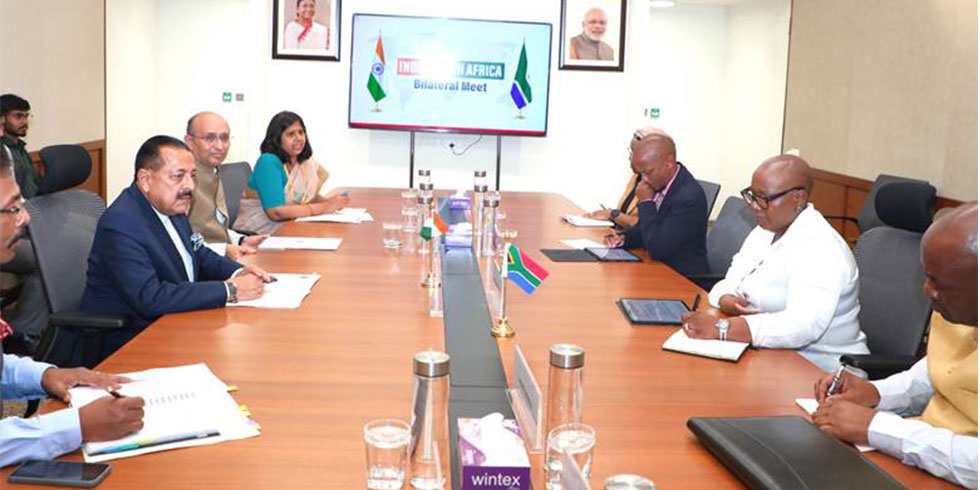
With AI, digital infrastructure, and advanced manufacturing emerging as top objectives for the next stage of bilateral engagement, South Africa and India decided to expand their bilateral cooperation in future technologies.
Union Minister Dr. Jitendra Singh urged moving the relationship beyond traditional research cooperation to innovation-driven partnerships capable of delivering economic and societal impact at scale during discussions with South Africa's Deputy Minister of Science, Technology and Innovation,Stated Dr. Nomalungelo Gina, who visited him with a high-level delegation.
Dr. Jitendra Singh stated that emerging technologies, innovation ecosystems, startup partnerships and industry-linked research must shape the next stage of India-South Africa engagement during bilateral talks with Dr. Nomalungelo Gina, South Africa's Deputy Minister of Science, Technology, and Innovation. According to him, the two nations' complementary strengths may be used to generate inclusive, scalable, and reasonably priced technological solutions for the developing globe.
According to the Minister, South Africa and India have a special alliance built on a shared commitment to inclusive growth, democratic principles and a shared history. He pointed out that both nations, as powerful representatives of the Global South, are advancing bilateral cooperation in a number of key areas while also increasingly influencing global discussions on science, technology, and innovation through forums like BRICS, IBSA, G20, and IORA.
The Kartavya Bhawan in New Delhi served as the venue for the gathering. Senior Department officials, DST Secretary Dr. Rajesh S. Gokhale, and representatives from the Ministry of External Affairs comprised the Indian delegation. Senior officials from the South African High Commission and the Department of Science, Technology, and Innovation made up the South African delegation, which was headed by Deputy Minister Dr. Nomalungelo Gina.
According to Dr. Jitendra Singh, significant governmental initiatives in the fields of artificial intelligence, quantum technologies, cyber-physical systems, digital public infrastructure, and startup-led innovation have helped India become one of the fastest-growing innovation ecosystems in the world. According to him, these developments offer fresh chances for cooperative research, technology development, and innovative collaborations with South Africa.
The resolution to step up cooperation in the India-South Africa Joint Committee mechanism's priority areas—Advanced Materials and Manufacturing, Geospatial Technologies and Digital Infrastructure—was a major result of the talks. In order to turn these key areas into tangible cooperative programs and results, all parties committed to quicken communication between scientists, organizations, and technical specialists.
Significant prospects in biotechnology, genetics, vaccine research, health technologies, and pandemic preparedness were also highlighted throughout the talks. Dr. Jitendra Singh added that India's strengths in biotechnology, affordable healthcare innovation, and vaccine manufacturing offer significant potential for collaboration with South Africa, and that recent global experiences have reinforced the importance of robust health care systems and scientific partnerships.
Since the bilateral S&T Agreement was signed in 1995, South Africa and India have maintained a strong collaboration in science and technology. Astronomy, biotechnology, health sciences, indigenous knowledge systems, renewable energy, sophisticated materials, and earth sciences are just a few of the fields in which the relationship has grown throughout time. Through organized institutional structures, the two nations continue to strengthen their cooperation and have jointly funded numerous scientific initiatives.
With the goal of producing significant benefits for both countries and supporting the Global South's larger development aspirations, the meeting ended with a shared resolve to forge a stronger, future-ready innovation partnership driven by research excellence, technology development, startup collaboration, and people-to-people scientific exchanges.


Add Comment